One inbox for all your accounts, shared with your agents.
Connect the mailboxes you already have, as many as you like, and read them together in one app that runs on your own machine. Your agents use the same accounts through the CLI or MCP, and whatever they draft waits for you.
The script checks the release's SHA-256 and installs to ~/.local/bin without sudo. Homebrew builds from source, so it installs Rust first.
Add it to your agent
/plugin marketplace add tymrtn/U1F4E7
codex plugin marketplace add tymrtn/U1F4E7
Then install envelope@envelope. The plugin adds a setup skill that walks your agent through connecting your accounts; you create the agent token yourself. Cursor: install Envelope from the Cursor Marketplace.
CLI + JSON + MCP for Claude Code, Codex, OpenHands, Hermes
Agent drafts wait for your approval
Use cases
One runtime. Several buying moments.
Many accounts, one inbox
Gmail, Fastmail, iCloud and your own domain land in one Unified Inbox, newest first. Search every account at once with Gmail-style operators, and archive or snooze across accounts in one pass. Each account keeps its own server, folders and address.
Your agent calls envelope code --wait 60 and blocks. When the OTP arrives, the CLI returns it. No polling loop, no parser, no race condition against your own inbox.
Reviewable Rules
Agent proposes rules based on what it found in your inbox. You see exactly which messages each rule would touch before anything moves. Confirm, edit, or reject. Rules export to Sieve if your server supports it.
Local dashboard
A mail client and an agent control plane on localhost. Read, search, star, archive, and triage mail, with keyboard shortcuts on the message list (c compose, x select, e archive, s star). The Review page collects drafts waiting for approval, scheduled sends, and failed auth; the Logs page keeps the history of what each agent did. Approve, edit, or discard agent work from one place.
Evidence Bundle
Export a thread as raw RFC822 files with a manifest and checksums. Useful when you need a verifiable record — for legal holds, compliance review, or a paper trail your agent assembled during an investigation.
See it in action
One inbox. Every agent. Full human control.
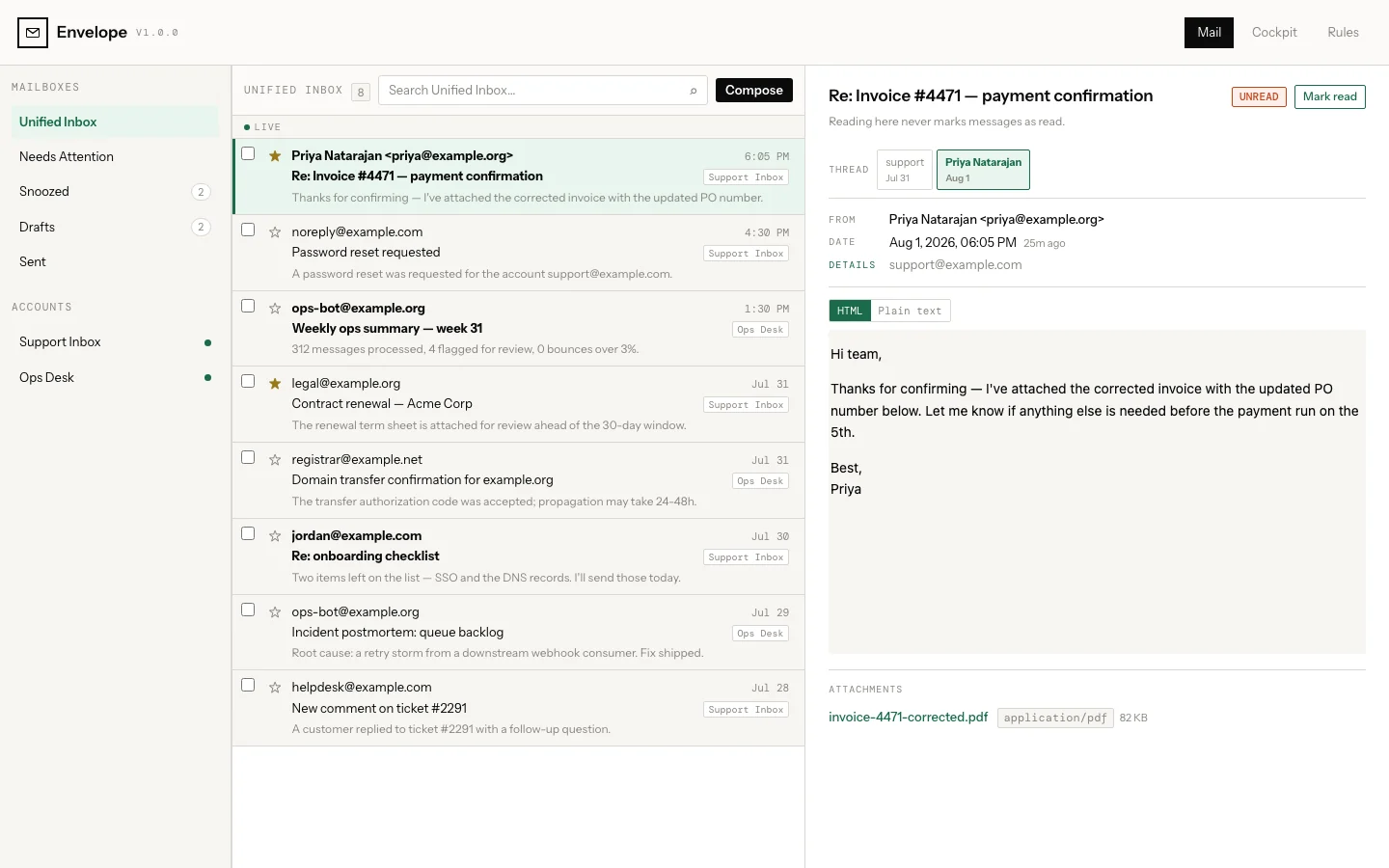
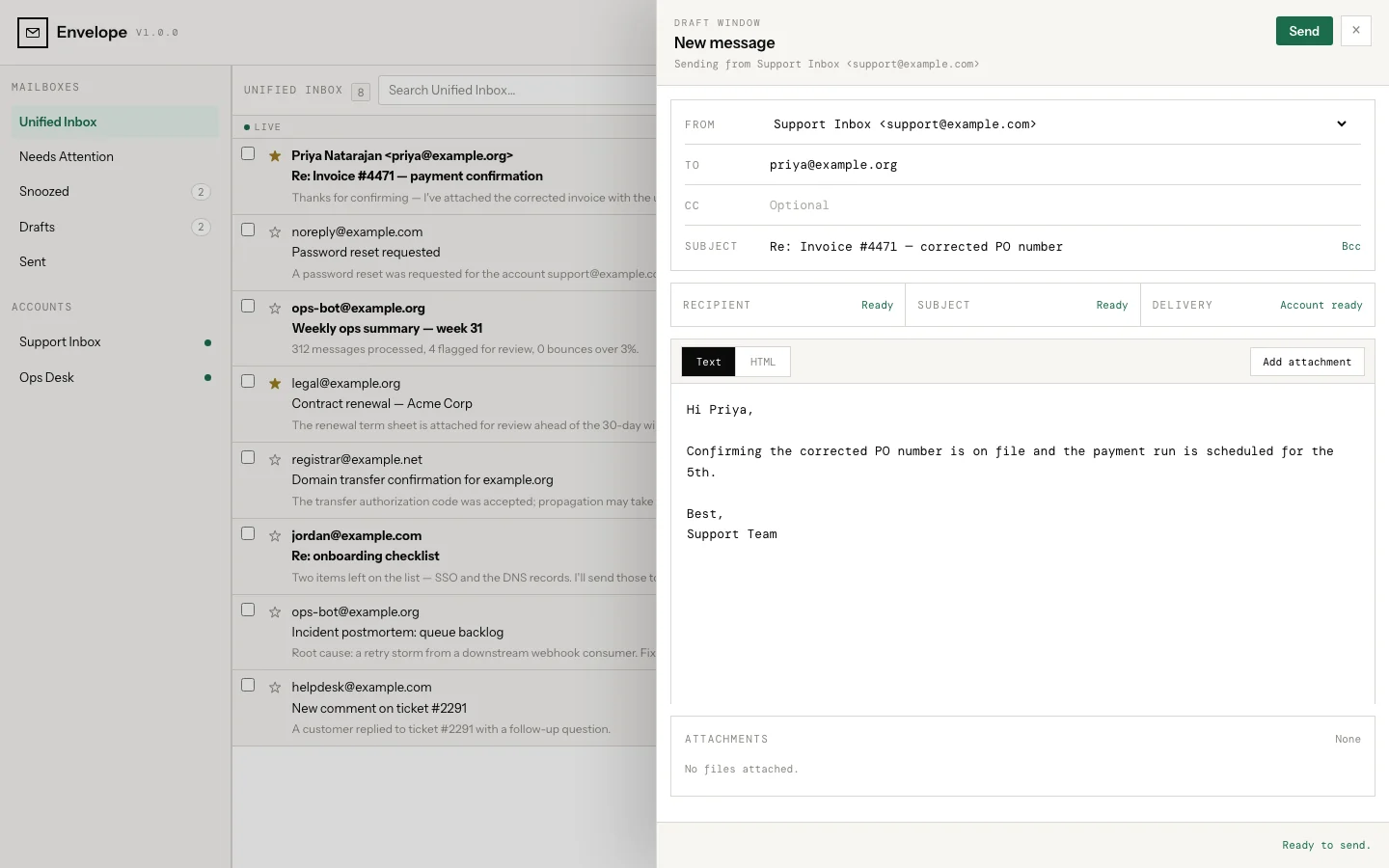
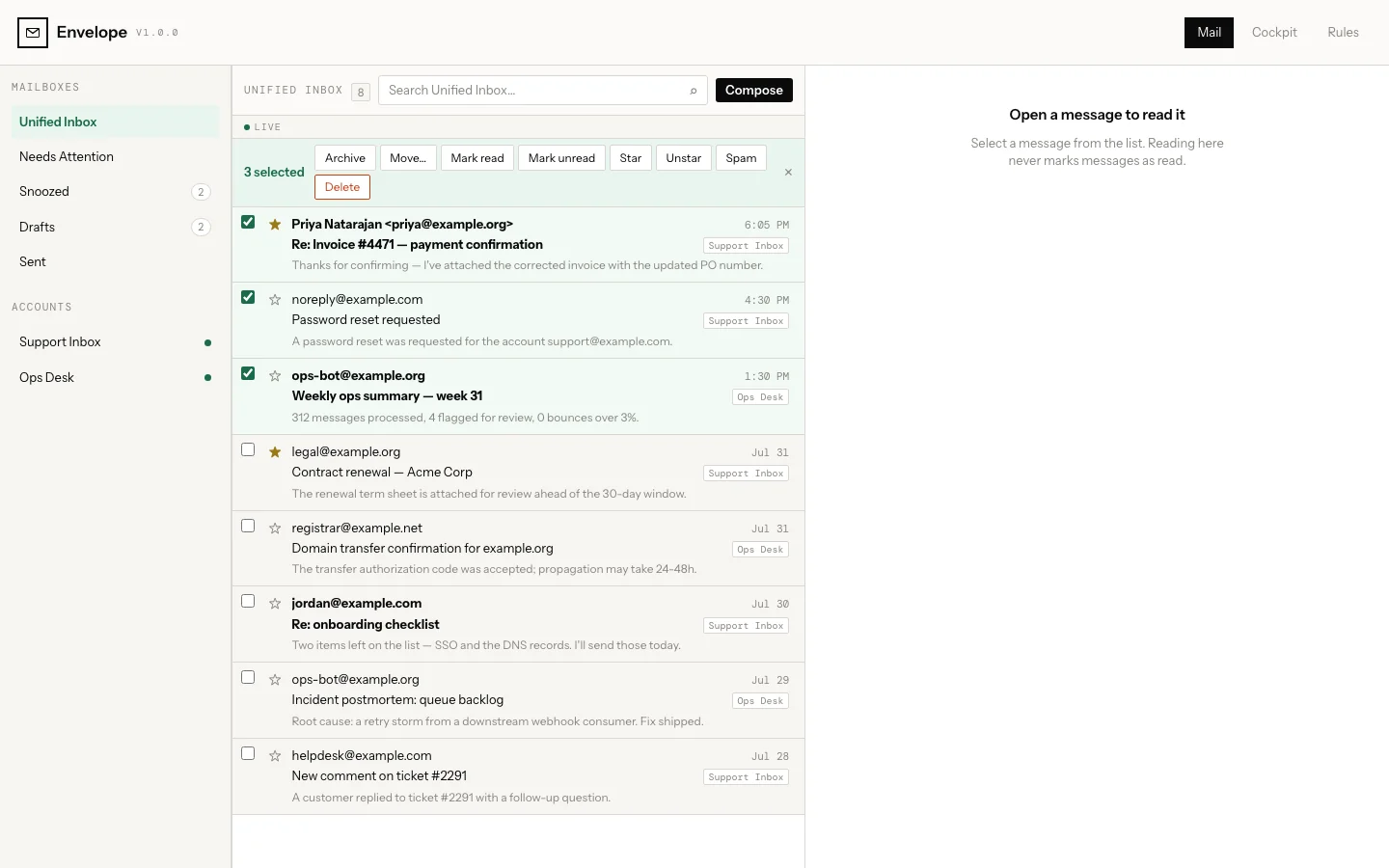
Read and triage mail from every account, review agent work, act on several messages at once, and write from whichever address fits, all in one app on your own machine.
Unified inbox + reader. Every account in one list, each row tagged with the address it came to, and the message open beside it.Write from any account. Pick the From address for each message while the inbox stays in view.Bulk triage across accounts. Select messages from different accounts, then archive, snooze, flag, or move them in one pass.
Human control
The agent doesn't send anything you haven't approved.
By default, every draft goes into a review queue. Rule runs preview affected messages before anything moves. The Logs page shows the full history. You can pause, override, or stop any workflow.
This isn't a safety flag bolted on at the end. Agent contexts default to draft-only mode. Autonomous send is an option, but you have to opt in explicitly — and every action is logged either way.
Send modes
draft-only — agent composes, you send (default)
confirm-send — agent sends after you approve
allowlisted-send — autonomous send to approved recipients
Every send decision produces a policy audit event. No secrets in the logs.
Works with your existing stack
Any harness. Most IMAP mailboxes.
If it can run a CLI command or speak MCP, it works with Envelope. Mailboxes that sign in with a password or app password work today, including Gmail, Fastmail, iCloud Mail, and Migadu; Outlook.com and Microsoft 365 need OAuth sign-in, which Envelope does not support yet. The same JSON surface works from a shell script, a Hermes pipeline, a Claude Code tool call, or a Codex exec loop.
Claude Code
Drop in via MCP. Full inbox access as a tool call.
OpenAI Codex
CLI + JSON surface for terminal-native autonomous loops.
Hermes
First-class skill for Hermes profiles and multi-agent pipelines.
OCPlatform
OTP handling, watch events, and thread-aware follow-up.
OpenHands
Long-running loops that wait on email before continuing.
Tailscale
Secure, identity-aware dashboard access across devices with Tailscale Serve.
Why not the alternatives?
Hosted services ask you to change. Envelope doesn't.
Robotomail, Cloudflare Agentic Inbox, and similar
These provision a new mailbox on their infrastructure. New address. DNS changes. Your mail in someone else's system. If your agent needs to operate on the inbox your contacts already use, you're at the wrong starting point.
Envelope connects to the mailbox you already have. Nothing migrates.
Mailgun, SendGrid, Postmark, Resend
If all you need is authenticated SMTP and a small API for product email, paying a third-party relay can be pure duplicate infrastructure. Envelope gives your own server a simple mail runtime without surrendering the mailbox or adding another vendor bill.
For huge marketing sends, use a bulk sender. For ordinary app email and agent workflows, BYO email is saner.
Himalaya and other IMAP CLIs
Solid tools built for humans reading their own mail. Envelope is built for the case where an agent is the primary consumer: IMAP IDLE watch, OTP extraction, JSON everywhere, reviewable rules, and a control plane for the human sharing the inbox with the agent.
Annual licensing
Personal use is free. Commercial rollout is a flat annual license.
Annual bands sized by mailbox users on your domain. No per-message metering, no seat trickery. Every paid band also lifts the free tier's two-agent cap.
Personal
Free
For individuals running their own mailbox
Personal, non-commercial use on your own mailboxes
Full CLI, dashboard, and MCP surface
Up to 2 active agent identities (a third asks for a license key)